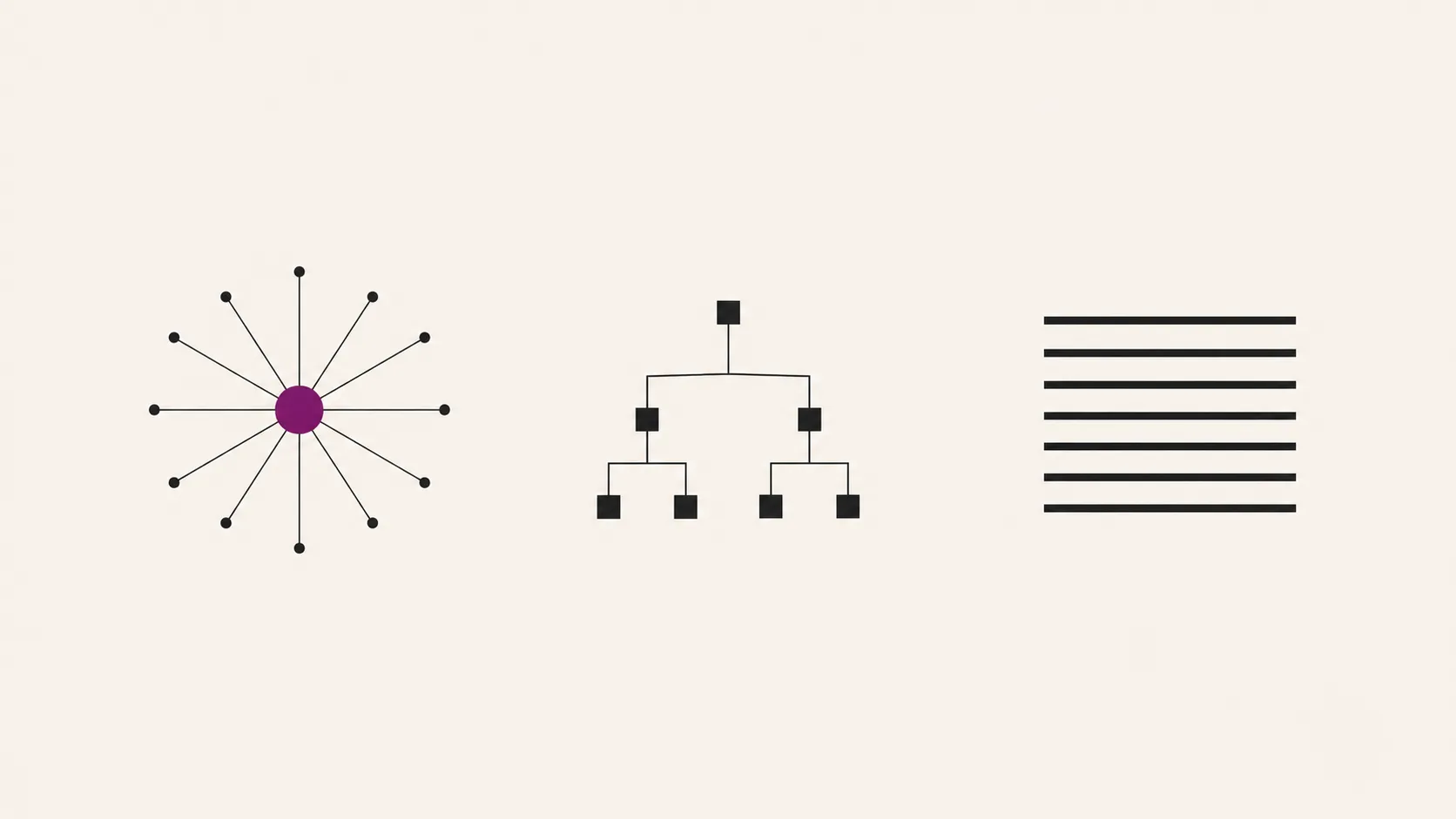
For about two years my entire BJJ notes system was a single Apple Note titled “Jits” — reverse-chronological bullet points in one giant scrolling file. By the time I gave up on it, the file was around 11,000 words and I couldn’t find anything in it. If you’ve done some version of this, you already know how the story ends.
That’s the most common failure mode for grappling notes, and it’s what sent me looking for a format with a different shape. I went through three.
Why bullet lists break
You learn a move on Tuesday and jot three bullets. Two months later you re-read them and the if is gone. Bullets capture what to do but not when to do it, and “when” is most of the technique. So the next time the position shows up in a round, your brain has the steps without the trigger, and you do nothing. (I wrote a whole post on this mechanism — it’s the root cause behind most “I forgot the technique” complaints.)
The important thing to absorb is that this isn’t a discipline problem. The format threw away the part you needed.
The mind map phase
A coach I trained with for a few months sketched positions on the whiteboard as radial maps — closed guard in the middle, sweeps and submissions branching off it. I copied the style for a while, in iThoughts and the usual apps.
It didn’t take, and the reason is interesting. In a mind map, everything connects to everything, and the format makes all connections look equal. “If they post their hand” and “if they sit back” sit side by side as two arrows off the same node, but in real time they route to completely different responses. Mind maps present those branches as peers when they’re actually a decision.
I’d still reach for a mind map to survey a position in the first week of learning it. Past that point, the format flattens exactly the information you’re trying to keep.
Where I landed
Flowcharts, mostly — and the reason is practical rather than theoretical. The format forces me to write the condition under each branch. “If their elbow comes in, then A.” I physically can’t be vague the way a bullet list lets me be vague, and that forced specificity costs more upfront and pays back every single time I re-open the chart.
Now the trade-off nobody mentions: flowcharts cost more to write. Bullets take 90 seconds. A real chart, drawn carefully, takes five or ten minutes, and the first time I tried to build the habit I quit twice. That friction was real, not a character flaw.
What eventually fixed it for me was building a tool that turns a voice memo into a first-draft chart, so the expensive part became editing rather than drawing. You don’t need software for this — hand-drawn charts work fine if you commit — but I personally had to get the cost below some threshold before the habit held.
<a class=“inline-cta” href=“https://grappleflows.com/register?utm_source=blog&utm_medium=referral&utm_campaign=post-mind-maps-vs-flowcharts-vs-linear-notes-bjj&utm_content=inline-cta&ref=blog”
Try it free Turn your next technique into a flowchart instead of a bullet list. Create a free account →
Bullets still have a job
Random thoughts, drill-of-the-day reminders, the thing my coach said in passing that I want to remember tomorrow — bullets are great for all of it. They make an excellent inbox and a bad archive. The mistake is asking the inbox to also be the long-term system.
A quick self-test
Pull up the last five notes you took after class and count how many you’ve re-opened since writing them. If the honest answer is zero or one, the format isn’t doing its job, and it’s worth trying a single technique as a flowchart this week to see whether the gap closes.
I’d rather you find out by trying it than take my word for it. The whole reason I switched formats is that I got tired of opening “Jits” and scrolling.