For about six months at blue belt the scissor sweep stopped working for me. Not because the technique was wrong, but because everyone above white belt knew how to counter it. I’d hit it in drilling, get countered every time in live rolling, and slowly stop trying it. That cycle is what almost every grappler goes through, and it’s the whole reason the scissor sweep has a reputation as a beginner move.
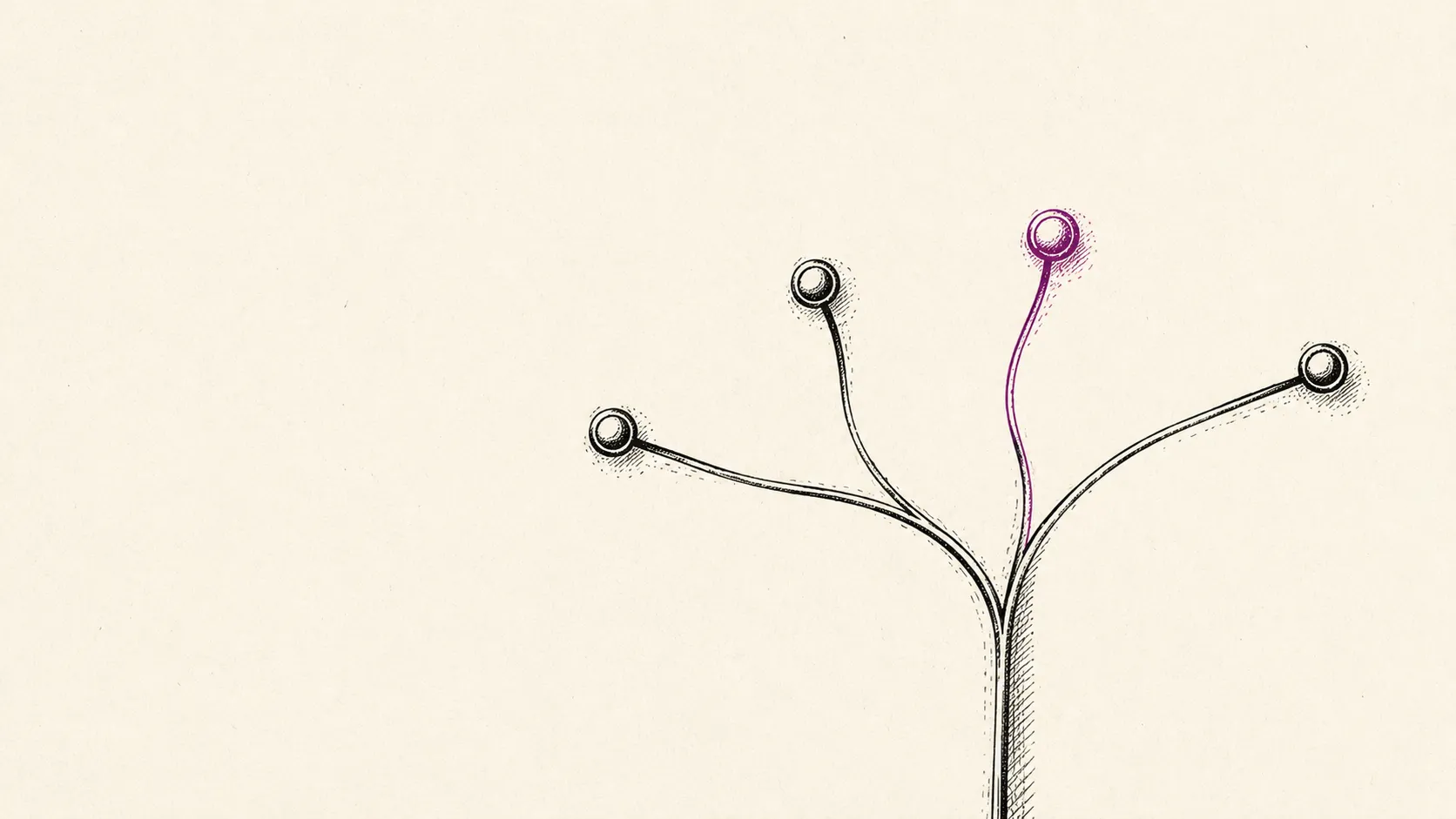
What fixed it wasn’t a new sweep. It was realizing the scissor was never a single move to begin with. It’s a four-branch attack tree, and the counters aren’t failures — they’re the entries into the other three branches. This is the post I wish I’d read before I gave up on it.
The sweep, restated
You know the version everyone learns. Cross collar grip, same-side sleeve, shin across the belly, opposite leg posted. Off-balance to the open side, kick across, sweep.
That version works until your opponent knows how to do any of four things. Then it stops working, and you conclude the technique is broken. It isn’t. You just stopped at branch zero.
Branch 1: they base out
The most common counter at every level. They feel the sweep starting and post their far hand on the mat to stop the rotation.
The instinct is to push harder against the post, and the instinct is wrong. Their posted hand has just told you exactly where their weight is, and where their weight is happens to be where the hip bump sweep wants it. Drop the collar grip, sit up into them, post on your trailing hand, drive your hip into their shoulder. The energy that was going into a scissor now goes into a hip bump in the same direction, and the posted arm they used to defend the first sweep is the arm you’re driving past for the second.
Most people learn this branch second, and it roughly doubles the sweep’s percentage on its own.
Branch 2: they posture up and stand
They sense the off-balance, stand, and start breaking grips. It’s pure defense, and it’s the counter I see most from higher belts who simply don’t want to play in your closed guard.
The answer is the kimura grip on their posted arm, swing the leg over the head, and finish with the kimura sweep or the armbar. Standing posture is exactly the angle a kimura wants — they hand it to you in the act of escaping. This branch looks the most advanced and is actually the cleanest of the four, because the geometry is so favorable once they stand. After twenty drilled reps the whole sequence feels mechanical.
Branch 3: they flatten you forward
The smart, experienced reaction. They sense the off-balance and dump their chest into yours to kill the angle.
The answer is the flower sweep, in the opposite direction. The weight they’re committing to flatten you is the same weight you use to roll them over. Trap the near arm with your collar grip, scoop the far leg, sweep over the top.
This is the branch most people never drill because the trigger is subtler — you have to feel them committing to the flatten before you redirect, and that timing doesn’t show up in static drilling. Five minutes of intentional partner work fixes it.
Branch 4: they retract the trapped leg
The trickiest counter. They pull back the leg you were about to sweep, which breaks the geometry entirely.
But the retraction creates the exact angle the omoplata wants: leg position over the shoulder, arm trapped. The sweep you couldn’t finish becomes a submission instead. I learned this branch last, and it’s the one that changed how I felt about the entire system, because it meant there was no longer any reaction that left me empty-handed.
One entry, four exits
You’re not learning four separate sweeps. You’re learning one entry where the opponent’s reaction picks the exit for you. That’s what branching means in practice, and it’s the thing that turns a “beginner sweep” into a high-percentage attack. The same reframe applies to most positions that have stopped working for you — I’ve written the same kind of breakdown for De La Riva and for lasso versus spider guard, and the pattern holds there too.
<a class=“inline-cta” href=“https://grappleflows.com/register?utm_source=blog&utm_medium=referral&utm_campaign=post-closed-guard-sweep-branches&utm_content=inline-cta&ref=blog”
Try it free Map the scissor sweep's four branches into one flowchart you can drill against. Create a free account →
The drill that wires it in
Specific rounds with a partner. They start in your closed guard, you start the scissor every time, and they pick one of the four counters each round while you hit the matching branch. Twenty minutes total, five per branch, in isolation.
After two weeks the routing becomes automatic, and the scissor stops failing — because the failure was always part of the plan. The sweep never changed. The way I thought about it did.