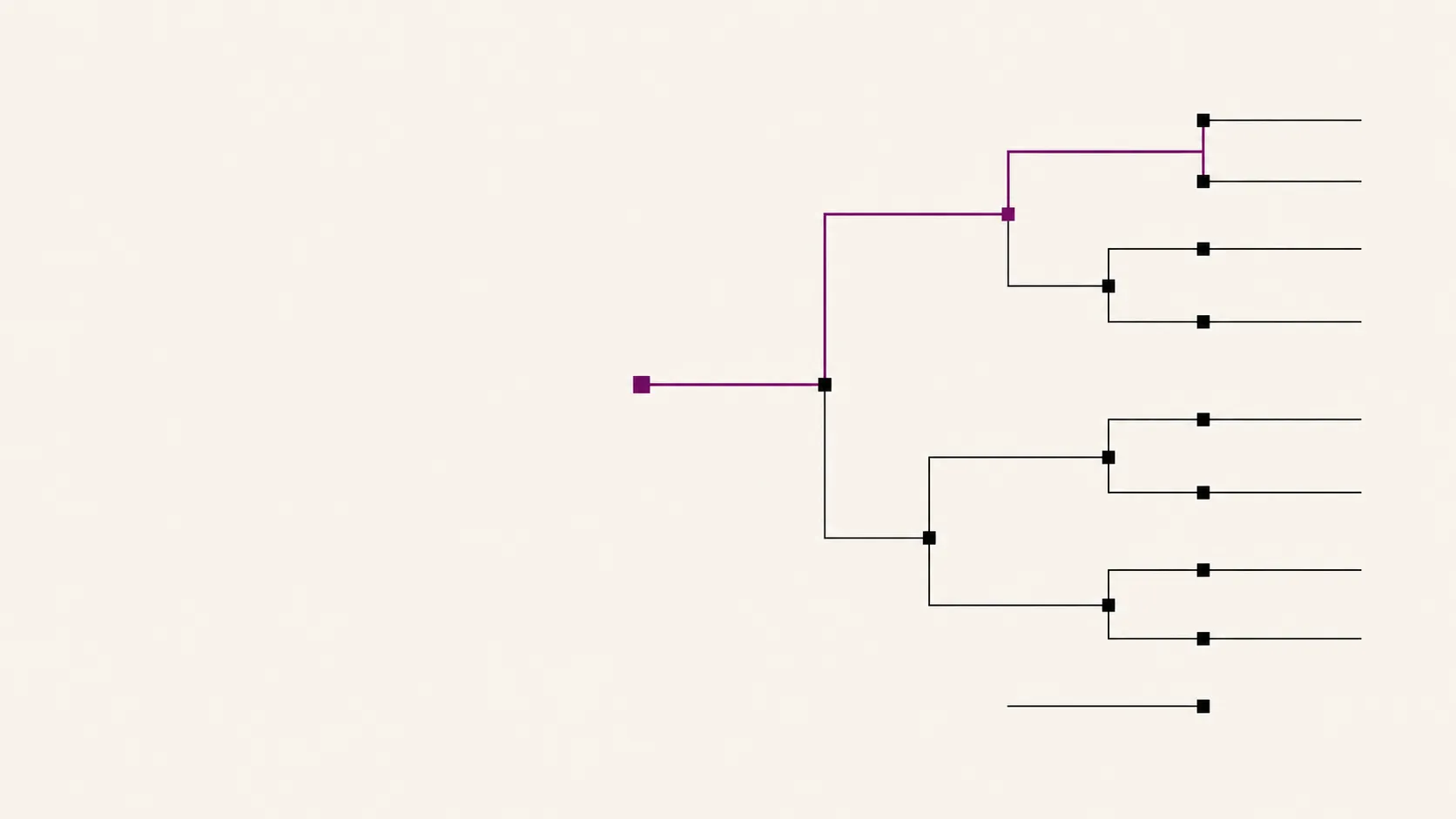
If you’re new to Brazilian Jiu-Jitsu competitions, the bracket sheet raises questions nobody at the gym thinks to answer. Why did someone get a BYE? Why is the highest-ranked competitor on the opposite side of the bracket from the second-ranked one? And how do IBJJF ranking points actually decide any of this?
This guide walks through how BJJ tournament brackets work, with a focus on IBJJF events — including an interactive bracket you can resize to see exactly where the BYEs land.
Common tournament formats
Most BJJ tournaments use one of three formats.
Single elimination
Single elimination is the simplest format: lose once and you’re out of the division. This is the format IBJJF uses.
Double elimination
In a double elimination tournament, you have to lose twice before you’re eliminated. This seems to be the most popular format for local tournaments — even if you lose your first match, you’re still guaranteed at least one more.
When I was a white belt, I competed in a lot of local double elimination tournaments. Losing my first match wasn’t the end of my day, which made them a great way to gain experience and get more value out of the registration fee.
Round robin
In a round robin, everyone in the division competes against everyone else. You’ll see this on Smooth Comp (one of the few BJJ apps still on my phone) as the Grappling Industries format — with a full bracket, it gives you the most matches of any format. It’s also common for very small divisions, where a traditional bracket wouldn’t make much sense.
How IBJJF brackets work
IBJJF uses a single elimination bracket: lose a match and your tournament is over, while the winner keeps advancing until a champion is decided. How big the bracket is depends on how many competitors register for the division.
What is a BYE?
A BYE lets a competitor skip the first round and advance automatically. They exist because tournament brackets work best with certain numbers of competitors.
For example:
- 8 competitors fit perfectly into an 8-person bracket.
- 16 competitors fit perfectly into a 16-person bracket.
- 32 competitors fit perfectly into a 32-person bracket.
But what happens when 13 people register? The tournament still uses a 16-person bracket, and the extra spots become BYEs.
Use the slider above to set any size and watch how the bracket grows and the BYEs shift. It starts at 13 competitors — notice the three BYEs land on the top three seeds, exactly the way IBJJF builds it. Want to try other sizes and formats for yourself? Open the full bracket tool.
How seeding works in IBJJF
Not all competitors are treated equally when the bracket is built. IBJJF seeds them by ranking points: the highest-ranked competitors receive any available BYEs, and the top seeds are spread across the bracket so they don’t meet each other in the opening rounds.
So if there are three available BYEs, the three highest-ranked competitors will usually get them. It’s a reward for athletes who consistently compete and perform well in IBJJF events.
How IBJJF ranking points work
IBJJF rankings are specific to your belt and age division. For example:
- Adult Blue Belt points do not count toward Adult Purple Belt rankings.
- Master 1 rankings are separate from Adult rankings.
When you earn a new belt, you start over and build points within that new division. Those points decide seeding and who receives the available BYEs, and points earned outside your primary weight class may be worth less than points earned within it.
You can look up the official rankings — and check your opponents’ points before you compete — on the IBJJF rankings page.
How to analyze your bracket
Once IBJJF publishes the brackets, you can start evaluating your division. A few things to look at:
Division size
The size of your division tells you how many matches it may take to win gold — a larger division generally means a longer path through the bracket.
Available BYEs
Check whether the bracket has any BYEs. If it does, look at the rankings to see who is likely to receive them.
Top seeds
Review the rankings of the competitors in your division. The highest-ranked athletes are usually the top seeds and will be spread across the bracket, which helps you anticipate who you might face later in the tournament.
<a class=“inline-cta” href=“https://grappleflows.com/register?utm_source=blog&utm_medium=referral&utm_campaign=post-how-ibjjf-brackets-byes-and-rankings-work&utm_content=inline-cta&ref=blog”
Prep smarter Map your A-game and likely matchups into a flow chart before you compete. Create a free account →
Podium placement and the open class
IBJJF awards medals to:
- First place
- Second place
- Two third-place finishers
Both competitors who lose in the semifinals take home bronze. And if you finish on the podium, you’re eligible to register for the open weight division at no extra cost — the sign-up desk is usually right near the podium after the medal ceremony.
Before you step on the mat
Understanding how IBJJF brackets work won’t make you better at Jiu-Jitsu, but it will help you understand the tournament you’re walking into. Before competing, take a few minutes to:
- Check the size of your division.
- See how many BYEs exist.
- Review the rankings.
- Identify the likely top seeds.
- Understand the path to the podium.
Once you’ve done that, stop worrying about the bracket and focus on competing. The six-week prep plan I use before a big tournament covers that part.
Common questions
What is a BYE in a BJJ tournament?
A BYE lets a competitor skip the first round and advance automatically. BYEs appear when the number of entrants doesn't fill the bracket exactly — the empty slots become BYEs, and IBJJF awards them to the highest-ranked seeds.
What bracket format does IBJJF use?
IBJJF runs single-elimination brackets. Lose one match and you're out of the division; the winner keeps advancing until a champion is decided.
How does seeding work in IBJJF?
IBJJF seeds competitors by ranking points. The highest-ranked athletes receive any available BYEs and are spread across the bracket so the top seeds don't meet until the later rounds.
How do IBJJF ranking points work?
Ranking points are specific to your belt and age division — Adult Blue Belt points don't count toward Purple, and Master divisions are separate from Adult. Points decide seeding and who receives the available BYEs.