Craig Jones’ Octopus Guard 2.0 isn’t a guard in the way most people think about guards. There’s no position to hold. It’s a connection-first scrambling system that takes a passer’s forward pressure and converts it into a chain of reactions you can ride straight to the back.
If you’ve watched someone make this look effortless while your version falls apart the second the passer reacts differently, the missing piece is usually the one this post covers.
The three ideas that make it tick
Attachment beats chasing. Most back-take games burn energy racing to the back. Octopus flips that: you stay connected to the passer, and the back becomes somewhere you end up rather than somewhere you sprint for. The grip and the hook do the work, and you follow the path that’s already there.
You’re steering their balance, not fighting their base. The whole system keeps putting the passer in spots where they have to post, step, square up, or turn — and each of those reactions opens something new. Instead of memorizing fifty techniques, you’re learning one much shorter rule: when they do X, they usually have to do Y next. That’s why the system scales. You’re reading patterns, not collecting moves.
Defense becomes offense in one step. Most guards feel like survival first, attacks later. Octopus collapses that gap: once the connection is right, the passer’s safest defensive choices are often the same ones that expose their back or dump them into a scramble where you’re already a step ahead.
The mistake almost everyone makes
The pattern shows up constantly with this system. Someone hits a slick entry once in training, the next partner reacts differently, they completely lose the thread, and they conclude it “only works on certain people” and quietly shelve it.
It works on everyone — but only if you stop treating it like a highlight reel of techniques and start treating it like a decision tree. Three questions, asked in order, get you most of the way there:
- What did they do with their base — wide, narrow, posted?
- What did they do with their hips — drop, lift, square?
- Did they square up, circle out, or try to crush forward?
Each answer cuts the menu of next moves down sharply. Drill the tree a few times and the reads stop feeling like reads; the position just tells you where to go. It’s the same reaction-first routing behind my four-branch De La Riva decision tree.
The flowchart
This is where it gets useful. I built a decision-tree flowchart that maps the whole system branch by branch, and every node links to a YouTube clip — highlights, rolls, breakdowns — showing that specific position or reaction live.
So you can see what each branch looks like in motion, not just read about it. Even without owning the instructional, the tree on its own gives you the mental model: study the patterns, watch the clips, recognize the shapes in your own rolls.
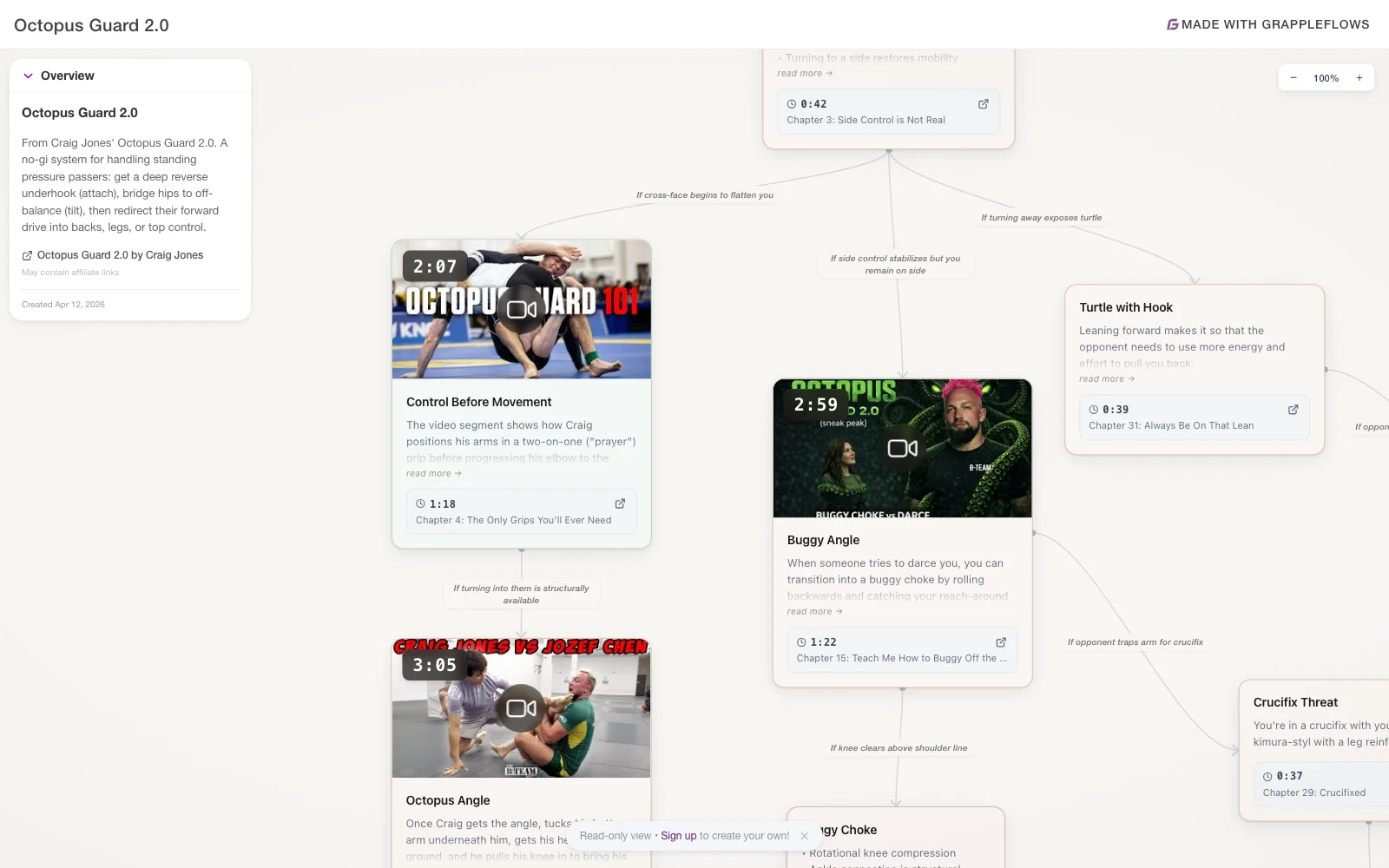
Open it on a second screen next time you’re studying. Between the branches and the clips, you’ll start recognizing the positions in your own rolls quickly — the same map-your-game idea the whole site is built around, applied to one system.
Where to get the instructional
Octopus Guard 2.0 by Craig Jones View on BJJ FanaticsHeads up: that’s an affiliate link — if you grab the instructional through it, I may earn a small commission at no extra cost to you. Appreciate the support.
Watch it with the flowchart open next to you. The whole thing clicks faster that way, and once it does, you stop trying to “play Octopus Guard” and just start ending up on the back.